Look at a map of any city and you are looking at centuries of human decisions layered on top of one another. The sharp medieval grid of Barcelona's Gothic Quarter gives way to the flowing diagonals of the Eixample, each block a precise chamfered octagon designed to let sunlight and air reach every apartment. In Tokyo the ancient temple roads still curve gently through neighbourhoods that have been rebuilt a dozen times. A map is not just geography, it is compressed history, and when you pull it out of a navigation app and onto a wall, something shifts. You stop seeing directions and start seeing stories.
Geometry as Identity
Cities reveal their character through their street patterns. The radial boulevards of Paris were carved by Haussmann to project imperial power and allow light to flood the city. Amsterdam's concentric canal rings reflect a mercantile society that valued order and water management in equal measure. New York's relentless grid speaks to ambition, efficiency, and the belief that a city should be navigable by anyone, not just those who grew up within its walls. When you choose a map poster, you are choosing a portrait of a city's personality, not a photograph of its skyline, but an X-ray of its bones.
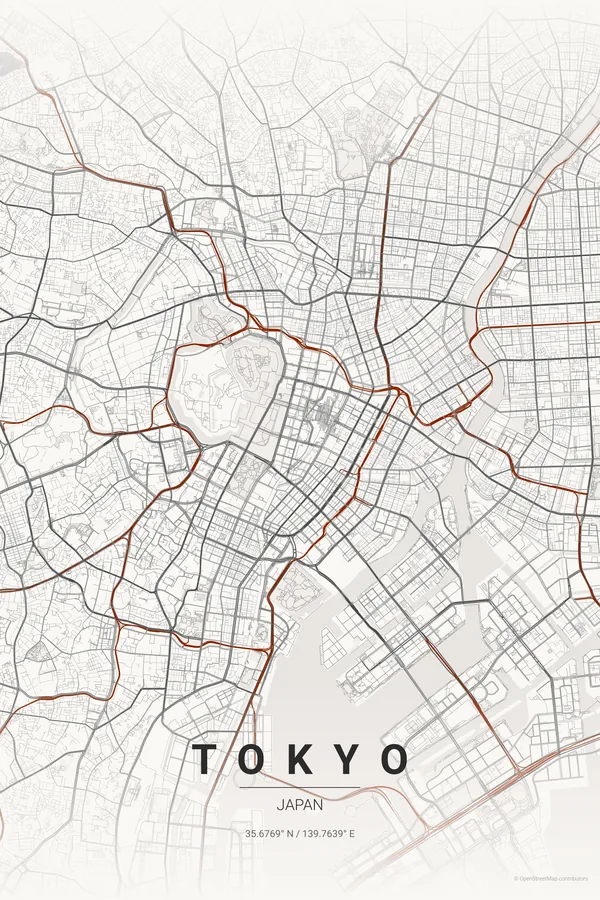
The Emotional Layer
There is a reason people are drawn to maps of places they love rather than places they have merely visited. A map of the city where you spent your university years does not just show streets; it encodes the walk from your apartment to the lecture hall, the shortcut through the park where you studied for exams, the corner bar where friendships deepened over long evenings. The lines on the poster become invisible threads connected to memory, and every glance at the wall pulls you back, not with the overwhelming detail of a photograph, but with the quiet abstraction of a diagram that lets your mind fill in the colour and sound.
Why Abstraction Works
Photography captures a moment; a map captures a structure. That structural quality is what gives map art its staying power on a wall. A photograph of Rome will always look like Rome on a specific day in a specific light. A map of Rome looks like Rome across all the days you have ever spent there and all the days you might spend there in the future. The abstraction invites projection, you see your Rome, not the photographer's. This is why map posters work in almost any interior: they carry meaning without dictating mood. Dark or light, minimal or detailed, the geometry speaks for itself and leaves room for the viewer's own narrative.

Choosing Your City
The best map poster is not necessarily the most beautiful city, it is the city that means the most to you. It might be a sprawling metropolis or a small coastal town with only a handful of roads. The emotional weight is what matters. When someone walks into your home and sees that poster, the first question is always the same: "Why that city?" And the answer, whatever it is, opens a door into who you are.